Pressure testing a heat exchanger is a vital step in confirming its integrity and safe operation. In industrial and marine systems, improper functioning can lead to leaks, equipment damage, and operational inefficiencies. Through pressure testing a heat exchanger, technicians can identify weak spots, check for leaks, and validate the structural soundness of the equipment before it enters service. The process involves carefully controlled pressurization, monitoring, and inspection to guarantee reliable performance under expected operating conditions.
The Purpose of Heat Exchanger Pressure Testing
The main goal of heat exchanger pressure testing is to verify that the equipment can withstand high-pressure conditions without failure. Heat exchangers often handle hot, cold, or corrosive fluids, making integrity testing essential to avoid unexpected leaks or system downtime. Pressure tests simulate operating conditions by filling the system with a test medium, usually water or air, and increasing the pressure above normal levels. This practice allows technicians to detect potential leaks, structural weaknesses, or gasket failures. Marine applications, in particular, demand pressure testing the marine heat exchangers to maintain operational safety at sea, where failures could have significant consequences.
Preparing for the Pressure Test
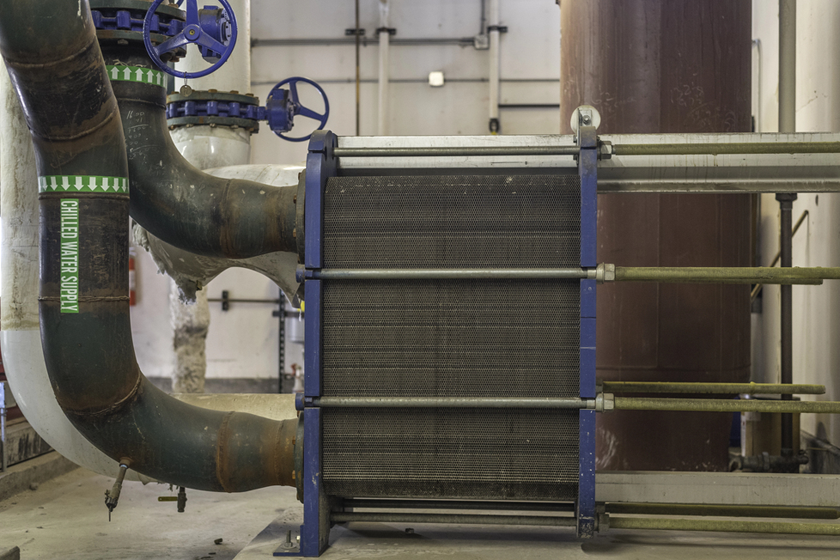
Before initiating a heat exchanger pressure test, the equipment must be inspected to confirm the proper assembly of plates or tubes. Plate heat exchangers rely on clamping bolts to secure plates between fixed and moving frames, creating separate passages for hot and cold fluids. The gaskets between plates must seal correctly to prevent mixing. For the test, one side of the media channels is pressurized while the other side remains unpressurized. This method helps isolate leaks that might not be visible if both sides were pressurized simultaneously. Technicians should also verify the inlet and outlet points according to design data or piping schematics, install blind plates, and prepare pressure gauges at high and low points to track the applied pressure accurately.
Executing the Pressure Test
During the heat exchanger pressure testing procedure, the system is gradually filled with the test medium, often water, to remove air pockets and ensure uniform pressure distribution. A hydraulic pump is typically used to increase pressure slowly while maintaining careful observation. The test pressure is usually set at 1.25 times the design pressure of the equipment, allowing the heat exchanger to be evaluated beyond typical operating conditions. This over-pressurization ensures the equipment can tolerate pressure spikes or abnormal flow conditions without failure. For marine heat exchangers, the test replicates operational stresses found in engine cooling and onboard fluid systems.
Monitoring and Inspecting for Leaks
Monitoring during the pressure test involves both visual and instrument-based inspection. Pressure gauges and transducers are used to record real-time pressure readings. Technicians should look for drops in pressure that could indicate leaks, structural weaknesses, or failing gaskets. In addition, visual inspections identify water or air bubbles escaping from the heat exchanger. Identifying these signs early prevents costly failures and allows repair or replacement of damaged components before the equipment enters service. This step is particularly important for applications such as swimming pool systems, laser cooling, or process systems, where fluid contamination or loss could have serious operational implications.
Post-Test Evaluation
Once the pressurization is complete, the heat exchanger is slowly depressurized. Technicians must then re-examine the system for any signs of permanent deformation, damage, or residual leaks. A successful test confirms that the heat exchanger is structurally sound and ready for operation. Any issues found during testing are addressed by tightening fasteners, replacing gaskets, or correcting assembly errors. Proper post-test evaluation ensures long-term reliability and prevents unexpected maintenance or operational interruptions.
Advantages of Professional Heat Exchanger Pressure Testing
Carrying out a comprehensive heat exchanger pressure testing procedure offers multiple advantages. First, it extends equipment lifespan by identifying weaknesses early. Second, it improves safety by minimizing the risk of leaks or catastrophic failures during operation. Third, for marine and industrial applications, testing helps maintain compliance with safety and operational standards. Using professional equipment and trained technicians also allows for precise measurement and analysis, improving the accuracy of the results.
Safer Equipment Alternatives
While manual pressure testing is effective, the use of advanced equipment can enhance accuracy and safety. Baron Blakeslee offers high-quality Spirec heat exchangers designed for both industrial and marine applications. These all-stainless steel units feature welded construction, single-pass design, and low pressure drop with enhanced turbulence. The compact modular design, broad temperature range, freeze tolerance, and self-cleaning effect make these heat exchangers easy to install, maintain, and integrate into existing systems. Using high-quality heat exchangers reduces the need for repeated or invasive pressure tests while maintaining operational reliability.
Common Considerations in Pressure Testing
When performing pressure testing a heat exchanger, technicians must account for media type, temperature, and system configuration. Water is often used as a test medium due to its incompressibility and safety, but air may also be used for specific applications. Temperature considerations are important to avoid material stress or thermal expansion issues. Correctly identifying inlet and outlet points, installing gauges, and controlling the pressurization rate all contribute to accurate and safe testing.
Applications in Marine and Industrial Systems
Pressure testing is not only essential for industrial systems but also for marine heat exchangers. Onboard vessels, heat exchangers handle engine cooling, water heaters, vapor recovery, and other critical functions. A failure at sea can lead to engine overheating, equipment damage, or unsafe operating conditions. Conducting rigorous pressure testing on marine heat exchangers ensures that vessels maintain operational efficiency and safety standards. Industrial systems benefit as well, from commercial washers to laser cooling systems, where heat exchangers are critical for maintaining process temperatures and system performance.
Upgrade Your System with Reliable Spirec Heat Exchangers
For professional heat exchanger solutions, explore Spirec heat exchangers from Baron Blakeslee. Our stainless steel units offer welded construction, single-pass design, low pressure drop, and compact modular options. They are freeze-tolerant, handle corrosive fluids, and provide broad temperature range operation. Installation is simple, maintenance is minimal, and performance is reliable, making them an ideal choice for industrial and marine systems. Contact us today to learn how our heat exchangers can enhance your system efficiency and operational safety.