
Vacuum Vapor Degreasing Systems
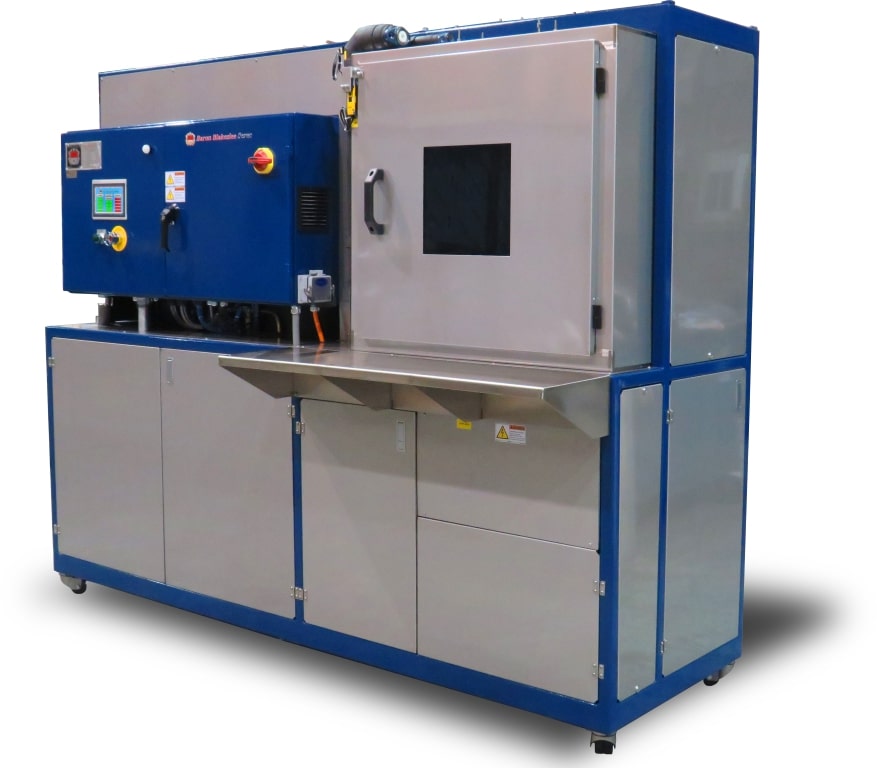
Open top vapor degreasers are efficient in terms of confining solvent and minimizing emissions, but tighter air regulations may make those solvent losses harder to shrug off. Vacuum vapor degreasing takes another route. Parts enter a sealed chamber, air is evacuated, and only then does solvent enter the process chamber. Baron Blakeslee manufactures our Airless Vacuum Vapor Degreasers in our own Factory in Williamstown, WV, and we have been in business since 1920.
- Choose from our complete selection of Baron Blakeslee systems:
- Custom VACUUM DEGREASERS
- Hydrocarbon Solvent Cleaning Systems
- VAC SERIES STANDARD VACUUM VAPOR DEGREASERS
- Degreasing Basics




Request Info
How the Airless Cleaning Cycle Works
From the outside, you see a process chamber door, and an HMI. Here's what happens behind the door:
- Load: Parts go into a basket or fixture. Parts with complex geometries or blind holes may be processed in a rotating or tilting basket so solvent reaches the hidden surfaces.
- Seal: The door locks against open air.
- Evacuate: A vacuum pump pulls the air out of the process chamber before a drop of solvent arrives.
- Vapor clean: Hot solvent vapor rushes in from the vapor supply tank and condenses on the cooler parts, dissolving oil on contact. Depending on the job, we follow that with hot or cool liquid solvent, filtered spray, or ultrasonics, and the operator configures the cycle based on the required process to clean and dry parts properly.
- Vacuum dry: The system draws vapor off to a heat exchanger, and parts dry inside the closed chamber. Our piece on the advantages of vacuum drying covers why blind holes respond so well to this step.
- Recover solvent: Condensate heads back to storage, pressure equalizes, and the door unlocks. Distillation kicks in automatically during the cycle, and operators can order an extra pass when soil loads are heavy.
Benefits of Vacuum Vapor Degreasing
Start with solvent consumption. The chemistry spends its entire working life in a closed loop, where it's recovered and distilled repeatedly. What finally leaves the machine is mostly concentrated soil.
Emissions control comes from the same sealed design, because air and solvent stay apart for the whole cycle. Plants using EPA-regulated halogenated solvent cleaning NESHAP pay close attention to that. Compliance at your site still depends on your chemistry, your permit, and how you run the machine.
Then there's flexibility in choice of solvent, which is often what brings people to Baron Blakeslee in the first place. With the oxygen removed from the process, we can run modified alcohols, aliphatic hydrocarbons, isopropyl alcohol, and acetone, and the lack of air also slows solvent breakdown. Plants phasing out chlorinated chemistries usually look to our modified alcohol and hydrocarbon degreasers, which use the same platform.
Operators benefit too. Nobody leans over an open vapor zone to load a basket, and the door stays locked until the chamber is cleared and returned to atmospheric pressure.
Vacuum vs. Open-Top Vapor Degreasing
We still build plenty of open-top vapor degreasers, and on a fast-moving line they can be the better fit. The trade-offs look like this:
| Factor | How the two designs compare |
|---|---|
| Where cleaning happens | A sealed, evacuated chamber on the airless side. An open tank under a tall freeboard on the other. |
| Solvent choices | Airless units take halogenated solvents plus hydrocarbons, modified alcohols, IPA, and acetone. Open-top machines stick with nonflammable halogenated and fluorinated blends. |
| Keeping vapor in | A closed loop does the work in a vacuum system. Open-top designs lean on freeboard height, refrigerated coils, and covers. |
| Drying | Inside the chamber under vacuum, compared with parts flashing dry at vapor temperature on the way out of an open tank. |
| Throughput | Vacuum machines run one load at a time through a door cycle. Open-top machines take baskets continuously, by hoist or by hand, which is hard to beat for sheer volume. |
Applications and Industries
Airless degreasing earns its keep on blind holes, threads, capillary spaces, and internal passages, places where trapped air would otherwise shield the surface from vapor. Aerospace and aviation components fit that description. So do medical devices and instruments, precision machined parts, stampings, castings, tubing, and bearings.
Automotive and general industrial plants also come to us, usually when a hydrocarbon or modified alcohol process replaces an older halogenated line.
Serec Engineering Heritage
Serec Corporation made its name as an American manufacturer of vacuum vapor degreasers. When Baron Blakeslee acquired Serec, we brought that Airless technology under our roof in Williamstown, where we now manufacture it with our own engineering and production methods. You can read more about our acquisition of Serec and what it means if you still run one of the original machines.
See the Airless Cycle Run on Your Own Parts
Spec sheets only carry a vacuum vapor degreasing decision so far. Seeing your parts come out of the chamber dry and ready for inspection usually settles it.
Ship us a sample batch and get in touch with Baron Blakeslee to schedule an airless trial.
FAQs
Cycle time depends on the load, the soil, and how many condensation and spray passes the process needs. Plan for longer cycles on dense castings and heavily soiled loads, and group similar parts to keep run times predictable. We time cycles during a trial with your parts, so throughput figures come from real data, not estimates.
Yes, ultrasonics are an option on our airless systems for metal parts with complex geometries. Because the vacuum process degasses the solvent, cavitation works more efficiently than it does in an aerated liquid. Ask us to include an ultrasonic stage in your trial so you can compare results with and without it.
Possibly, and it usually depends on which solvent you run and how your state or local agency classifies the facility. An Airless Vacuum Vapor Degreaser offers the lowest emissions technically possible, but it doesn't exempt a site from compliance. Share the solvent you plan to use with your local air quality authority early, and we can provide equipment details for that conversation. More answers sit on our airless vacuum vapor degreasing FAQs page.
Standard VAC Series units cover typical part sizes and cycles with proven configurations. Go custom when a part will not fit a standard chamber or when the machine must feed an automated line through conveyors and material handling. Start with your largest part and your hourly volume, and our engineers will tell you which route fits.