Manufacturing standards are rising faster than ever, and cleanliness is at the center of it all. Across aerospace, medical, automotive, and semiconductor production, the margin for contamination has gradually disappeared.
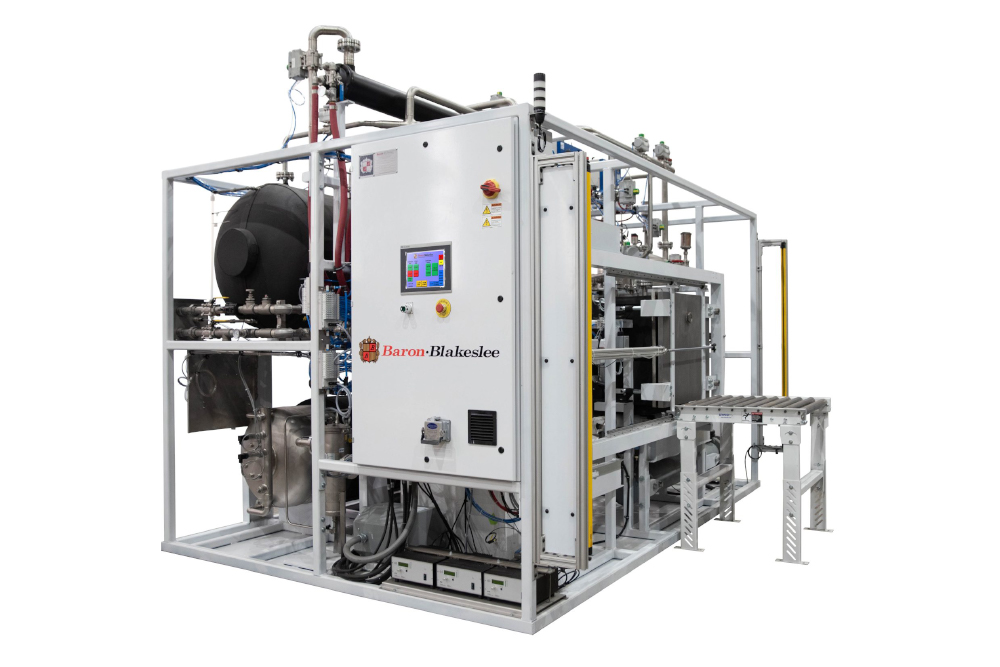
Precision metal cleaning systems are fundamental to product integrity, regulatory compliance, and operational efficiency. At Baron Blakeslee, we have spent over a century engineering cleaning solutions that meet the demands industries face.
Why Precision Metal Cleaning Systems Are Redefining Manufacturing Quality
The scale of what's happening in industrial cleaning right now is significant. The precision cleaning solutions market is projected to grow from USD 7.67 billion in 2025 to USD 9.85 billion by 2030. Automated systems are replacing manual cleaning in more than half of factories globally.
What's driving this? Largely, it's the tightening of cleanliness specifications across high-stakes industries. Post-cleaning contaminants (both solids and residues) must now be verified to be less than 1 micron in size for many applications. In aerospace, contamination failures account for more than 22% of aircraft part rejections. In the medical field, microscopic debris on an implant or surgical instrument poses a safety concern.
Our range of industrial cleaning equipment has been developed with exactly these realities in mind. We design and manufacture systems for clients operating in some of the most demanding environments in the world.
The Changing Market of Cleaning Technologies
Vapor degreasing has long been a preferred method in precision manufacturing, and for good reason. It delivers superior, repeatable cleaning results without secondary drying, eliminates cross-contamination between parts, and handles complex geometries efficiently.
On the other hand, aqueous cleaning systems have gained significant ground. This is largely because of their environmental advantages and their ability to reduce hazardous waste compared to solvent-based systems.
The EPA's Toxic Substances Control Act reviews have imposed significant restrictions on legacy solvents such as TCE and PCE. PFAS-containing fluorinated solvents are facing phase-outs across multiple states and internationally.
France implemented new PFAS product restrictions in January 2026, and similar legislation is accelerating across North America. Manufacturers who haven't started evaluating their cleaning chemistry are already behind.
Automation, IoT, and the Next Generation of Clean
Digital monitoring and smart system integration are becoming standard expectations. IoT-based tracking in cleaning equipment has grown among manufacturers seeking tighter operational control.
Real-time analytics, predictive maintenance, and automated cycle management help facilities reduce downtime. They also help reduce wastewater generation. These technologies support verifiable and traceable cleaning results.
This is especially important in aerospace and semiconductor manufacturing, where particle removal requirements fall below 5 microns. Every cleaning cycle must be documented for compliance.
Precision Cleaning Solutions, Built for What's Next
Tighter tolerances, stricter regulations, and more complex part geometries are leading the industry toward smarter, more sustainable, and more adaptable cleaning systems. We have been engineering solutions to these challenges since 1920, from custom crossrod degreasers to closed-loop solvent recovery systems. All are designed and manufactured at our facility in Williamstown, WV.
Reach out to Baron Blakeslee to find the right cleaning solution for your application, your industry, and your compliance requirements.