Quick Summary: PTFE coating selection depends on the component, required film properties, carrier chemistry, application method, drying requirements, and production controls. A structured evaluation helps manufacturers compare formulations, qualify equipment, and establish a repeatable process instead of selecting a coating based on a single performance claim.
Knowing how to choose the right PTFE coating for industrial use starts with the finished component, not the coating label.
A formulation that performs well on one substrate or geometry may be poorly suited to another. Film thickness, friction, chemical exposure, temperature, flexibility, and production volume all shape the selection.
At Baron Blakeslee, we approach coating selection as an application engineering decision. The coating chemistry and equipment should work together as a complete process. Early testing can identify wetting behavior, drainage characteristics, drying requirements, and fixture needs before production begins.
Define the Performance Requirement First
Start by identifying what the coated surface must accomplish.
PTFE is commonly selected for low friction, release properties, chemical resistance, and dry lubrication. The priority depends on the application. A medical device component may require smooth actuation, while an industrial part may need reduced sticking or controlled surface interaction.
Convert these objectives into measurable performance criteria such as actuation force, friction, coverage, film thickness, adhesion, wear resistance, or chemical compatibility. Clearly defined specifications make it easier to distinguish a suitable coating from one that simply appears acceptable.
Match the Formulation to the Substrate
The substrate directly affects wetting, adhesion, drying, and long-term coating performance.
Metals, polymers, elastomers, glass, and composite materials all respond differently to carrier fluids and thermal exposure. Surface energy, roughness, previous treatments, and contamination can also influence how the dispersion deposits across the component.
Review the coating supplier’s compatibility data, then confirm performance using representative production parts. Some formulations require a primer, a specific cleaning process, or a defined surface condition. Testing should also evaluate swelling, stress cracking, discoloration, corrosion, and dimensional changes after drying and conditioning.
Compare Carrier Fluids and Drying Requirements
PTFE particles remain suspended in a carrier fluid that wets the component before leaving the deposited coating behind. Water-based, solvent-based, and alcohol-carried formulations differ in drying characteristics, compatibility, ventilation requirements, and facility considerations. Process design should follow the supplier’s technical and safety documentation.
Drying temperature is especially important for heat-sensitive components. Some formulations require only controlled evaporation, while others require a separate curing or sintering stage. Every PTFE dispersion follows its own processing requirements.
The coating manufacturer’s recommendations should establish the starting point, followed by qualification using actual production parts.
Choose an Application Method That Controls the Film
Dip coating can be effective for small, precision components because immersion depth, dwell time, withdrawal speed, and drainage can be controlled.
Part orientation and geometry influence where fluid collects, how the wet film levels, and which surfaces remain exposed. Masking or controlled immersion may be needed when only a defined section receives coating.
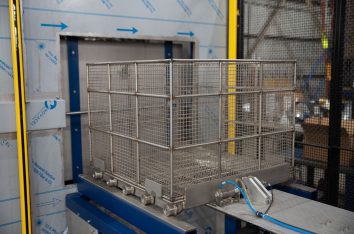
Purpose-built coating systems can improve repeatability through stable bath mixing, temperature management, programmable motion, and controlled carrier recovery. Equipment should match the coating volume, component dimensions, fixture arrangement, throughput, and required level of automation.
Evaluate Equipment for the Specific Carrier Chemistry
Equipment design must account for the carrier fluid. A nonflammable formulation and a flammable alcohol-carried formulation may require different pumps, controls, ventilation, electrical classifications, and safeguards.
Using equipment that was not designed for chemistry can introduce unnecessary operational and safety risks.
Our Lab Koat Series Coater is designed for precise immersion coating and controlled withdrawal of medical and dental device components. For PTFE formulations with an isopropyl alcohol carrier, the Lab Koat IPA is engineered for Class 1, Division 1 environments and uses an air-operated diaphragm pump for fluid circulation.
Study Film Thickness, Drainage, and Part Geometry
Film thickness depends on more than the solids concentration.
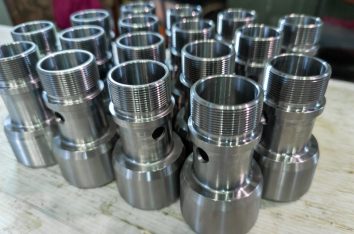
Withdrawal speed, viscosity, bath temperature, component orientation, surface condition, and drainage time all influence the deposited coating. Features such as holes, shoulders, narrow gaps, and abrupt diameter transitions might potentially retain additional fluid or produce varying coating deposition.
Understanding these variables is an important part of learning how to choose the right PTFE coating for industrial use, especially for components with complex geometries and demanding performance requirements.
Review Production, Quality, and Maintenance Needs
A coating process that performs well during laboratory testing should also fit daily production requirements. Evaluate cycle time, loading methods, fixture capacity, changeover procedures, bath life, filtration, equipment access for cleaning, operator training, and recordkeeping.
Traceable process recipes and documented inspection methods simplify investigations into process variation while maintaining consistent production quality.
Validate the Complete Process Before Release
Qualification should use production-intent components, fixtures, coating batches, and drying conditions. Inspect coating appearance and coverage, then evaluate the properties tied directly to product performance requirements.
When applicable, testing should also include aged components, repeated actuation, sterilization exposure, chemical resistance, packaging conditions, and other downstream requirements.
Document approved process settings, acceptable operating limits, bath monitoring procedures, handling methods, inspection frequency, and corrective actions for out-of-range conditions. This transforms a successful coating trial into a controlled manufacturing process.
Revalidation may be appropriate whenever the substrate, formulation, fixture, equipment, or drying schedule changes.
Select a PTFE Coating Process With Baron Blakeslee
Baron Blakeslee has engineered and manufactured standard and custom industrial equipment in the United States since 1920.
We can evaluate your parts, coating chemistry, throughput, carrier fluid, and facility requirements to develop an application approach. Our team also assists with testing, installation, training, technical service, replacement parts, and equipment needs. Contact us today for more details!