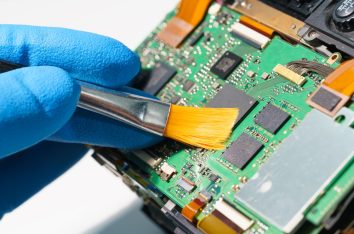
Circuit boards carry tighter tolerances, smaller geometries, and higher performance expectations than ever before. Residues left behind during soldering, rework, or handling can quietly compromise reliability long after a product ships.
Flux activators readily attract moisture, while ionic contamination promotes corrosion and dendritic growth, and protective coatings may fail to adhere as intended. Although these issues rarely present themselves immediately, they are frequently traced back to a single overlooked step in the process: effective cleaning.
Vapor degreasing has remained a trusted solution for electronics for decades because it addresses these risks at their source. The method delivers controlled, repeatable cleaning without water, without aggressive mechanical action, and without relying on operator technique.
At Baron Blakeslee, we have supported electronics manufacturers for generations with systems that fit real production environments rather than idealized lab conditions. Let’s understand how vapor degreasing fits into modern circuit board cleaning and how best practices separate reliable results from costly rework.
Vapor Degreasing Circuit Board Cleaning in Practice
Vapor degreasing circuit board applications rely on a simple physical principle with powerful results. Heated solvent produces vapor that rises within a sealed system and condenses on cooler assemblies. That condensation dissolves flux residues, oils, and ionic contaminants at the surface level. As the solvent drains off the board, it carries those soils away and returns to the system for reuse.
This approach delivers several advantages that matter in electronics manufacturing:
- Fresh solvent contacts the assembly during every cycle
- Cross-contamination is minimized since soils remain in the boil sump
- Assemblies exit the process dry and ready for inspection or coating
Dense component layouts, low standoff heights, and fine-pitch features benefit from vapor cleaning because the vapor reaches areas that aqueous cleaning, sprays and wipes often miss. The result supports both cosmetic standards and long-term electrical reliability.
Why Circuit Boards Benefit from Vapor-Based Cleaning
Not all residues lead to immediate failures, as many issues develop gradually when moisture interacts with residual flux chemistry or fabrication contaminants. Vapor degreasing mitigates these hidden risks by removing them before they evolve into field-related problems.
Flux residues left behind after soldering often contain acids, activators, and ionic compounds. Over time, these materials draw in ambient moisture and create pathways for corrosion or current leakage. Vapor cleaning breaks that cycle by fully dissolving and removing the residue rather than redistributing it across the board surface.
Conformal coating introduces an additional consideration, as coatings depend on clean surfaces to achieve proper adhesion. Even residues classified as “no-clean” can interfere with bonding and lead to localized lifting or delamination. Vapor degreasing supports coating performance by ensuring surfaces are uniformly clean and dry prior to application.
Understanding Solvent Behavior and Process Stability
Cleaning performance depends heavily on solvent behavior inside the system. A vapor degreaser solvent should remain stable through repeated boiling and condensation cycles. Azeotropic and near-azeotropic formulations meet this requirement because their composition remains consistent in both vapor and liquid states.
Solvent stability affects more than cleaning strength. Fractionation over time can change flammability characteristics, solvency, and safety margins. Stable formulations reduce that risk and simplify long-term operation.
Environmental and regulatory considerations also influence solvent selection. Many manufacturers continue moving away from legacy chemistries with higher toxicity profiles. Modern solvent options support practical electronics cleaning while aligning with evolving compliance expectations.
Process validation plays a central role here. Testing with actual assemblies and real soils allows cleaning parameters to be established before production begins. That groundwork saves time and avoids surprises after installation.
Process Control Matters More Than Aggression
Electronics cleaning generally relies on precision rather than force. Vapor degreasing systems rely on precise temperature management to define the vapor zone and prevent solvent loss. Cooling coils establish the condensation boundary, while heaters maintain consistent boiling conditions.
Airflow around the system deserves careful attention. Drafts disrupt vapor containment and increase solvent loss, which affects both safety and operating cost. Proper placement, away from doors, vents, and fans, helps maintain process stability.
Facility Considerations that Influence Results
System location plays a larger role than many teams expect. Space requirements affect access for maintenance, solvent handling, and safety equipment. Ceiling height matters when processing long or vertically oriented assemblies. Larger systems may require stairs or platforms for safe operation.
Humidity control represents another often-overlooked factor. Moisture absorbed into specific solvent formulations can lead to chemical degradation over time. Facilities with stable humidity levels enable monitoring of trends and prompt corrective action before performance suffers. Vapor degreasers include sub-zero freeboard refrigeration coils which provide dehumidification, which in conjunction with a gravity style water separator, remove moisture from the process effectively.
Pit installations introduce their own concerns. Proper ventilation becomes important in recessed areas, both for safety and for vapor control. Planning these details early avoids costly retrofits later.
Vapor Degreaser Maintenance as a Reliability Tool
Cleaning performance does not remain consistent by accident. Vapor degreaser maintenance complements reliability as much as the initial system design. Regular inspection identifies leaks, worn seals, and refrigeration issues before they disrupt production.
Key maintenance areas include:
- Solvent containment systems, such as sumps and return lines
- Refrigeration capacity to manage condensation heat loads
- Heating controls and safety interlocks
- Water separation and moisture management
Routine checks confirm that temperatures match setpoints and that solvent behavior remains predictable. Additionally, documentation can help support audits and reinforce process discipline.
Integrating Vapor Degreasing Into Production Flow
Successful implementation begins upstream. Flux type, soldering temperature, and time between assembly and cleaning all influence results. Higher temperature soldering tends to bake residues more firmly onto surfaces, which may require longer exposure or adjusted parameters.
Process development treats cleaning as part of the overall manufacturing system rather than an isolated step. Standard operating procedures can help translate validated settings into repeatable routines. Any upstream change prompts a review to confirm continued compatibility.
Manufacturers seeking scalability benefit from vapor degreasing’s flexibility. Systems are able to integrate well with automated handling, batch processing, and varied production volumes without sacrificing consistency.
From Precision Cleaning to Long-Term Performance
Electronics cleaning rarely earns attention when it works well. Problems surface when residues remain, and reliability suffers months or years later. Vapor degreasing addresses that risk by removing contaminants completely and consistently.
Teams evaluating advanced cleaning options often explore purpose-built electronics cleaning equipment designed specifically for precision assemblies. Others focus on system configurations and process options available through modern vapor degreasers engineered for demanding environments.
Vapor Degreasing as a Foundation for Reliable Electronics Manufacturing
Circuit board cleaning supports reliability, coating performance, and long-term product success. Vapor degreasing delivers those benefits through controlled solvent behavior, predictable process parameters, and disciplined operation. When the system, solvent, and facility work together, results follow naturally.
At Baron Blakeslee, we bring decades of experience helping manufacturers translate cleaning theory into practical, production-ready solutions.
From process evaluation and testing to installation and ongoing support, our role centers on assisting teams to achieve consistent results. Reach out to us today to see how precision cleaning can enhance your operation.