Quick Summary: A repeatable PTFE coating process depends on clean components, stable dispersion chemistry, controlled immersion and withdrawal, and documented inspection. This guide explains the primary stages of a liquid dispersion workflow and how purpose-built equipment improves consistency, traceability, and operator control.
The PTFE coating process converts a liquid fluoropolymer dispersion into a thin, functional layer on a prepared component. In medical and dental device manufacturing, that layer may reduce friction and improve actuation. Reliable results depend on controlled chemistry, clean components, repeatable motion, drying or curing, and inspection standards for the application.
At Baron Blakeslee, we design equipment for precise PTFE dispersion coating. The sequence below describes an immersion workflow. Settings vary by substrate, formulation, geometry, film thickness, production rate, and regulatory obligations.
Understanding PTFE Dispersion Coating
PTFE, or polytetrafluoroethylene, is recognized for its low friction, chemical resistance, and release properties. Fine PTFE particles remain suspended within a carrier fluid until application. The carrier may consist of water, isopropyl alcohol, or another chemical specified by the coating manufacturer.
As the component is withdrawn from the bath, the liquid leaves a controlled layer across the surface. The carrier then evaporates during a specified drying stage.
Some formulations require a separate thermal cure, while others form a dry-film lubricant after controlled drying. Processing limits should always follow the coating supplier’s technical data.
Step One: Define the Application Requirements
Translate the product requirement into measurable targets. Identify the substrate, coated area, film thickness, friction or actuation objective, throughput, and inspection method. Part geometry matters because narrow passages, sharp transitions, and complex profiles influence drainage and uniformity.
These factors shape tank dimensions, fluid volume, mixing, withdrawal travel, fixture design, ventilation, and controls. Our coating systems are available in standard and custom configurations for repeatable PTFE dispersion application.
Step Two: Prepare and Clean the Components
Coating performance starts with a surface free of oils, machining residue, fingerprints, dust, and incompatible chemicals.
Contamination may interfere with wetting, create bare spots, or cause visible defects. Select a cleaning method compatible with the substrate and the coating manufacturer’s requirements.
After cleaning, rinse when required and dry the components. Residual moisture or cleaner can dilute the dispersion or change surface contact. Handle prepared parts with clean tools or gloves and limit the time between cleaning and coating.
Step Three: Condition and Mix the PTFE Dispersion
PTFE particles naturally settle over time, so the dispersion bath must remain homogeneous without damaging the formulation.
Follow the supplier’s recommendations for storage temperature, conditioning, agitation, filtration, and usable bath life. Excessive mixing can introduce air bubbles, while insufficient circulation may create concentration differences throughout the bath.
Step Four: Fixture and Mask the Parts
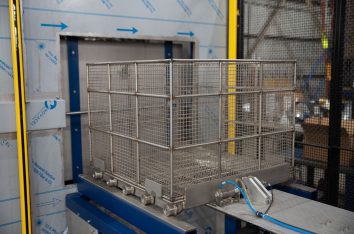
A fixture should hold each component securely, expose the specified area, and allow excess fluid to drain predictably. Spacing helps prevent contact, shadowing, and transfer marks. Fixture materials must be compatible with the chemistry and cleaning procedure.
When only a defined area needs coating, masking, or controlled immersion depth can protect adjacent surfaces. A repeatable stop position is more reliable than visual judgment and makes the process easier to validate.
Step Five: Immerse the Components
Lower the prepared components into the dispersion at a controlled rate. Smooth entry helps reduce trapped air and disturbance at the fluid surface. Establish immersion depth and dwell time through application testing.
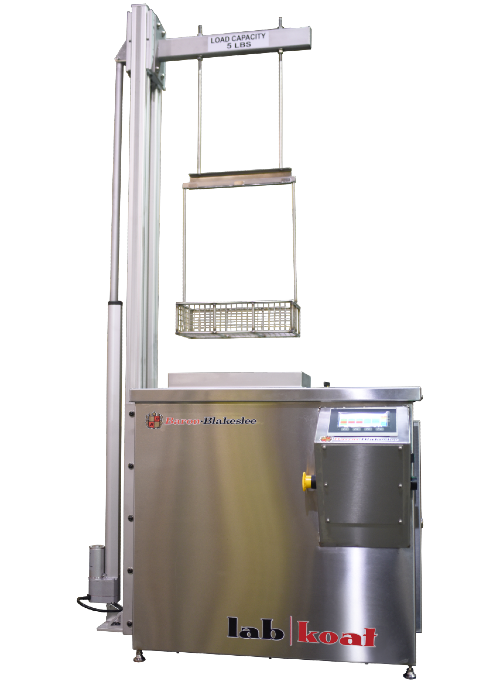
For precision medical device work, the Lab-Koat Series Coater uses circulation, temperature control, and controlled movement to promote uniform deposition. Qualified settings can be repeated across production cycles.
Step Six: Control the Withdrawal Rate
Withdrawal is one of the most critical stages in the PTFE coating process.
Speed, fluid properties, part orientation, and drainage all influence the wet coating thickness. Stable, programmable motion improves coating uniformity while giving excess carrier fluid time to return to the tank.
Withdrawing parts too quickly may create uneven deposits, runs, or excessive coating thickness. Withdrawing them too slowly may produce a film outside the desired specification. Testing should establish a validated withdrawal profile for every part family.
Step Seven: Dry or Cure According to the Formulation
Place coated components in the specified drying environment without allowing contact or airborne contamination. Temperature, airflow, humidity, and time can influence evaporation and final appearance. Flammable carrier fluids require equipment and facility controls suited to the classified environment.
For PTFE dispersions with an IPA carrier, our Lab Koat IPA is designed as an explosion-proof, intrinsically safe system for Class 1, Division 1 applications. The drying or cure schedule must follow the coating manufacturer’s instructions and the validated process.
Step Eight: Inspect and Document the Coated Parts
Inspection confirms that the completed coating meets the required specification.
Evaluation may include appearance, coverage, film thickness, lubricity, friction, actuation force, adhesion, or functional testing. Sampling plans and acceptance criteria should reflect the component’s intended application and quality standards.
Document coating batches, recipes, operators, fixtures, processing times, temperatures, inspection results, and any deviations. Strong traceability makes it easier to distinguish isolated defects from changes in bath condition or equipment performance.
Improving Repeatability Through Process Control
A capable process remains stable because key variables are measured and maintained. Review withdrawal speed, bath temperature, mixing, fluid level, filtration, fixture condition, and drying parameters at planned intervals. Preventive maintenance keeps pumps, controls, coils, and motion systems operating as intended.
Before full production, application testing can establish an operating window rather than one ideal setting. This creates practical limits for normal variation and a stronger basis for training, validation, troubleshooting, and scale-up.
Build a Consistent Coating Process With Baron Blakeslee
Baron Blakeslee has manufactured robust industrial equipment in the United States since 1920. We combine application evaluation, testing, engineering, installation, training, replacement parts, and technical service in a personalized approach.
Talk with our team about a standard or custom PTFE dispersion coating system designed around your chemistry, components, safety requirements, and production goals.