Quick Summary: An air-to-air heat exchanger transfers thermal energy between outgoing exhaust air and incoming fresh air without mixing the two streams, reducing the demand placed on a building’s heating and cooling systems. Flat plate and rotary wheel configurations accommodate different flow rates and installation requirements, while sensible and total energy recovery designs differ in whether they also transfer moisture between air streams. The same heat recovery principle extends to industrial gas and vapor applications, where capturing exhaust heat to preheat incoming process air can reduce fuel consumption and overall energy costs. Maintaining performance over time requires regular filter changes and periodic cleaning to prevent dust and particulate buildup on the heat transfer surface.
Facilities that continuously exchange indoor and outdoor air for ventilation often lose a significant amount of energy in the process, which is exactly the problem an air-to-air heat exchanger is designed to solve. Rather than letting conditioned air escape without recovering its thermal value, this equipment transfers heat between the outgoing exhaust stream and the incoming fresh air stream, reducing the load on heating and cooling systems.
Baron Blakeslee’s Spirec heat exchangers extend this same heat recovery principle into industrial vapor and gas applications, and this guide covers how air-to-air recovery works.
The Basic Principle
An air-to-air exchanger separates two air streams with a thin, conductive surface that transfers heat from the warmer stream to the cooler one without allowing the two air flows to physically mix. During winter, outgoing warm exhaust air preheats cold incoming fresh air. During summer, the process operates in reverse, transferring heat away from incoming air before it enters the conditioned space.
The exchanger maintains separate flow paths so the two air streams can exchange thermal energy without coming into direct contact. This separation is especially important in ventilation systems where maintaining indoor air quality is a key consideration.
System effectiveness depends on factors such as the heat transfer surface, airflow rates, temperature difference, and condition of the transfer surfaces during operation.
Common Configurations
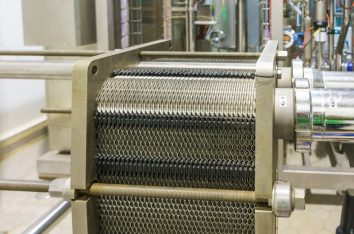
Flat plate designs direct air streams through alternating channels, similar in concept to a liquid plate exchanger. Rotary wheel designs use a slowly rotating heat-absorbing medium that captures heat from one air stream and releases it into the other as the wheel turns. Each configuration is suited to different airflow rates, layouts, and available installation space.
Choosing between flat plate and rotary configurations depends on the application’s airflow requirements, available installation space, maintenance expectations, and heat recovery objectives. Flat plate units have no moving parts, while rotary systems continuously move the heat transfer medium between the two air streams.
Each design has distinct characteristics for managing thermal recovery in commercial and industrial ventilation systems.
Sensible Versus Total Energy Recovery
Sensible heat exchangers transfer only temperature-related heat, while total energy recovery units, sometimes called enthalpy wheels, also transfer moisture between the two air streams. The appropriate choice depends on the specific ventilation requirements and whether humidity control is a priority within the space.
Industrial Applications Beyond HVAC
The same heat recovery principle used in building ventilation applies to industrial processes that vent warm exhaust gas or vapor, where recovering that thermal energy to preheat incoming process air or gas reduces overall fuel and energy demand across the facility.
Efficiency Considerations
The effectiveness of an air-to-air exchanger depends on the temperature differential between the two streams, the surface area available for heat transfer, and how well the unit resists air leakage between the exhaust and supply sides, since cross-contamination reduces both efficiency and air quality.
Maintenance and Fouling
Dust, grease, and other airborne particulates can accumulate on exchanger surfaces over time, reducing performance much like fouling does in liquid systems. Regular filter changes and periodic cleaning of the heat transfer surface help maintain rated efficiency.
Maintenance requirements depend heavily on the cleanliness of the incoming and exhaust air streams. Facilities handling grease, dust, fibers, chemical vapors, or other contaminants might require more frequent inspection and cleaning.
Keeping filters in good condition reduces the contaminant load reaching the exchanger, while monitoring pressure drop and thermal performance can help identify developing fouling.
Add Heat Recovery to Your Facility’s Process Design
Recovering energy between air or gas streams is one of the more straightforward ways a facility can reduce utility costs without changing its core process. Baron Blakeslee’s Spirec heat exchangers apply proven heat recovery principles to industrial liquid, gas, and vapor applications, and our technical information resources help identify the right configuration for a given flow rate.
Talk to our team about incorporating heat recovery into your facility’s process design.
Frequently Asked Questions
What is the difference between sensible and total energy recovery?
Sensible recovery transfers only temperature-related heat between air streams, while total energy recovery also transfers moisture, which matters most in facilities where humidity control affects product quality or comfort.
How much energy can an air-to-air exchanger actually save?
Savings depend on climate, operating hours, and the temperature differential between indoor and outdoor air, but recovering even a portion of exhaust heat meaningfully reduces heating and cooling loads over a year.
Can air-to-air heat recovery principles apply to industrial gas streams?
Yes, the same heat transfer concept used in building ventilation applies to recovering heat from industrial exhaust gas or vapor streams to preheat incoming process air.
What maintenance does an air-to-air exchanger require?
Regular filter changes and periodic cleaning of the heat transfer surface prevent dust and particulate buildup from reducing the unit’s rated efficiency over time.