Quick Summary: A spiral heat exchanger uses a single, continuous flow channel that can handle viscous and fouling-prone fluids more effectively than many multi-channel designs. Its coiled geometry also fits a considerable amount of heat transfer surface into a compact footprint. Counter-current flow promotes efficient thermal exchange and can achieve closer approach temperatures, while the gradual flow path can reduce the risk of thermal shock compared with designs featuring frequent, abrupt changes in direction. Self-scrubbing flow helps limit fouling buildup, potentially extending maintenance intervals and reducing downtime throughout the equipment’s service life. Cylindrical-plate exchangers offer several of these same characteristics, giving facilities a welded and compact alternative when comparing equipment for liquid, gas, and vapor applications.
Facilities evaluating thermal equipment options for demanding fluid streams often consider a spiral heat exchanger because of how well the design handles fouling and viscosity challenges that trip up other configurations.
While Baron Blakeslee’s Spirec heat exchangers use a cylindrical-plate rather than a spiral geometry, both designs share the same underlying goal of maximizing heat transfer in a compact, self-cleaning format, and understanding the reasons facilities choose spiral or spiral-adjacent technology helps clarify what to look for in any compact exchanger.
Strong Performance With Viscous Fluids
Spiral heat exchangers can process viscous fluids effectively because their continuous flow path minimizes sharp turns and sudden directional changes. This flow arrangement helps keep thicker fluids moving through the exchanger while limiting areas where they could slow down or stagnate.
Spiral configurations can therefore suit oils, slurries, and other process streams where high viscosity can interfere with consistent heat transfer performance.
Effective Handling of Fouling-Prone Streams
The geometry of a spiral exchanger promotes turbulence that helps sweep deposits away from heat transfer surfaces as the fluid moves through the equipment.
This self-cleaning action can be especially valuable when processing streams containing suspended solids, fibers, sludge, or other contaminants. Limiting deposit accumulation helps preserve thermal performance and can reduce the number of cleaning-related interruptions required during operation.
Compact Footprint for the Surface Area Provided
A spiral configuration uses a coiled flow path to incorporate a substantial heat transfer surface into a relatively small package. This arrangement can be valuable for industrial facilities with limited floor space or equipment rooms that cannot accommodate a larger exchanger.
Its compact construction can also simplify equipment placement when new thermal equipment must fit within existing piping systems and established plant layouts.
Counter-Current Flow for Efficient Heat Transfer
Counter-current flow moves the hot and cold streams in opposite directions through the exchanger,. This helps maintain a useful temperature difference across a large portion of the heat transfer surface.
The arrangement can achieve close temperature approaches while using the available surface area efficiently. In demanding process applications, thermal effectiveness can affect equipment sizing as well as ongoing energy and operating costs.
Lower Risk of Thermal Shock
Spiral flow paths distribute fluid movement and thermal exposure more gradually throughout the exchanger instead of concentrating abrupt changes across multiple directional transitions. This characteristic can help moderate thermal stresses during startup, shutdown, and shifts in operating temperature.
Material selection and actual operating conditions remain important factors, but the flow geometry can contribute to dependable performance during repeated thermal cycling.
Reduced Maintenance Downtime
The turbulence and continuous flow associated with spiral construction can reduce localized deposit buildup and help maintain consistent heat transfer surfaces.
When fouling is controlled effectively, maintenance intervals can become easier to manage and unexpected shutdowns can be reduced. Facilities can also benefit from simpler cleaning routines when the exchanger design allows access to the relevant flow channels.
Versatility Across Liquid, Gas, and Vapor Applications
Spiral heat exchangers can be configured for a variety of thermal duties involving liquids, gases, vapors, and combinations of these process streams. Their compact construction and counter-current flow make them suitable for applications such as liquid cooling, process heating, condensation, and heat recovery.
The appropriate configuration depends on fluid properties, pressure, temperature, flow rate, and required thermal performance.
Discuss Your Compact Heat Exchanger Requirements
Whether a facility ultimately selects a spiral, cylindrical-plate, or another compact exchanger design, the underlying priorities are usually the same: strong performance with difficult fluids, a small footprint, and manageable long-term maintenance.
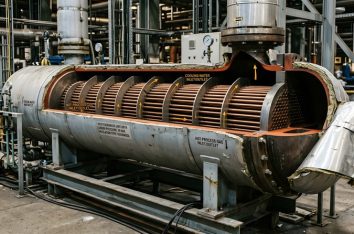
Baron Blakeslee’s Spirec heat exchangers deliver on these same priorities through a welded, single-pass, all-stainless-steel design, and our cross section views show how the internal flow path supports both efficiency and self-cleaning performance. Facilities also managing solvent recycling alongside their thermal equipment can consolidate multiple process needs with Baron Blakeslee as a single supplier.
Speak with our applications team about which compact exchanger design best fits your fluid and space requirements.
Frequently Asked Questions
What makes spiral heat exchangers good for viscous fluids?
The single, continuous flow channel accommodates thick or viscous fluids without the uneven flow distribution risk that can occur in narrower, multi-channel plate designs.
How does a spiral design help with fouling-prone fluids?
The continuous channel creates a scrubbing action as fluid moves through it, which helps manage solids, fibers, and sludge that might otherwise clog a multi-channel exchanger.
Is a cylindrical-plate exchanger a good alternative to a spiral design?
Yes, cylindrical-plate exchangers offer similar compactness and turbulence-driven efficiency, along with a welded, gasket-free construction suited to a wide range of liquid, gas, and vapor applications.
Do compact exchanger designs require less maintenance than traditional shell-and-tube units?
Often yes, since self-cleaning flow patterns slow fouling buildup, which can extend the interval between required cleanings compared with lower-velocity shell-and-tube designs.