Quick Summary: A plate and frame heat exchanger keeps two fluids separated by thin, corrugated metal plates, allowing heat to pass through each plate wall without direct contact between the fluids. The corrugated pattern promotes turbulence even at relatively low velocities, while a counter-flow arrangement maintains a more uniform temperature difference throughout the unit. This configuration can achieve closer approach temperatures than parallel-flow designs. Cylindrical-plate variations adapt the same technology into a more compact shell while using welded, gasket-free construction that helps withstand corrosion and fouling. These characteristics make plate and frame exchangers suitable for liquid, gas, and vapor heat transfer applications where installation space is restricted or process fluids have a tendency to form deposits.
Industrial facilities that need to transfer heat between two fluids without mixing them often turn to a plate and frame heat exchanger because of its compact footprint and strong thermal performance. Rather than relying on long tube bundles inside a shell, this design stacks a series of corrugated plates that force fluid into thin, turbulent channels, maximizing surface area within a small volume.
Baron Blakeslee supplies Spirec heat exchangers that apply this principle in cylindrical form, and this article walks through how the design works and where it fits best.
The Core Concept
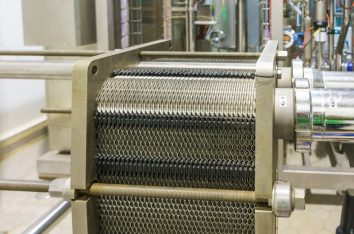
A plate heat exchanger keeps two fluid streams apart with a thin metal plate, allowing thermal energy to pass from the hotter fluid to the cooler one without the streams coming into direct contact. Several plates arranged in a stack form alternating channels, directing the hot fluid through one set of passages and the cooler fluid through the adjacent passages in the opposite direction.
The thin metal barrier between the fluid streams creates an effective path for heat transfer while keeping the two circuits physically separate. Since the plates provide a large heat transfer surface within a relatively compact assembly, this configuration can handle substantial thermal loads without the extended equipment lengths required by many conventional exchanger designs.
Why Plate Geometry Matters
The corrugated or dimpled pattern formed into each plate serves a purpose beyond structural reinforcement. It directs the fluid along a winding path that promotes turbulence at comparatively low velocities. This improves heat transfer efficiency compared with the smooth, relatively straight passages found in many traditional tube-and-shell configurations.
Greater turbulence also reduces the thickness of the thermal boundary layer that develops along the heat transfer surface. As a result, thermal energy can move between the two fluids more readily while the exchanger maintains strong performance within a compact arrangement.
Engineers can select different corrugation patterns according to the required flow characteristics and pressure limitations.
Counter-Flow Arrangement
Most plate exchangers operate with a counter-flow arrangement, where the two fluids travel in opposite directions through their respective channels. This configuration preserves a more consistent temperature difference along the exchanger, helping the unit reach a closer approach temperature than a typical parallel-flow arrangement.
Counter-flow operation becomes especially useful when the desired outlet temperature of one fluid approaches the inlet temperature of the other.
The configuration makes more effective use of the available temperature difference and may reduce the heat transfer surface required for a specific thermal duty. This efficiency contributes to the compact footprint associated with plate exchanger technology.
Single-Pass Versus Multi-Pass Configurations
With a single-pass configuration, each fluid moves through the exchanger one time before leaving the unit. This straightforward arrangement simplifies the flow path and can make maintenance more convenient.
Certain applications require multi-pass configurations, which send the fluid through multiple sections of the exchanger to increase heat transfer, although this approach can introduce additional complexity and pressure drop.
The ideal configuration depends on several factors, including thermal duty, flow rates, pressure restrictions, and target temperatures. Single-pass systems can be advantageous when simple operation and lower pressure drop are important considerations.
Multi-pass arrangements, on the other hand, can increase heat transfer within a defined installation footprint. Engineers need to weigh these variables when selecting the appropriate flow arrangement.
Compact Cylindrical-Plate Variations
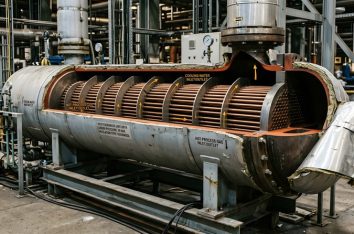
Spirec’s cylindrical-plate design forms the plate surface into a compact cylindrical shell rather than arranging it as a conventional flat stack.
This configuration can further reduce the required footprint while retaining the turbulence-driven heat transfer characteristics associated with plate technology. The design also uses welded, gasket-free construction, which can perform reliably under pressure and in environments involving corrosive process fluids.
The cylindrical format can be useful when conventional rectangular plate-and-frame equipment cannot accommodate the available installation space. Welded construction also eliminates gasket interfaces from the process path, reducing potential leakage points.
This characteristic makes the design appropriate for applications involving elevated pressures, higher temperatures, or chemically aggressive fluids.
Materials and Construction
Stainless steel is commonly used for plate and frame exchangers in demanding industrial applications because it provides corrosion resistance across a broad range of process fluids while handling the pressure differences encountered in liquid, gas, and vapor heat transfer systems.
The appropriate material ultimately depends on the fluids being processed and the operating conditions of the exchanger.
Stainless steel combines corrosion resistance, mechanical strength, and effective thermal characteristics, while specialized alloys may be appropriate for particularly aggressive process environments. Welded construction can also strengthen fluid containment and contribute to dependable long-term operation.
Where Plate and Frame Designs Excel
Applications involving liquid-to-liquid, liquid-to-gas, or vapor-to-liquid heat transfer with moderate to high flow rates tend to favor plate and frame designs, particularly where floor space is limited or where the process fluid is prone to fouling and benefits from the design’s turbulence-driven self-cleaning effect.
Their compact size makes these exchangers useful in facilities where equipment space comes at a premium. They can also be adapted to a broad range of thermal duties, making them suitable for process heating, cooling, condensation, and heat recovery. Proper sizing remains important, particularly when fluids contain suspended solids or have significant fouling potential.
Find the Right Plate Heat Exchanger for Your Application
Understanding the working principle behind a plate exchanger helps engineers select the right configuration for their specific flow rates, temperatures, and fluid characteristics.
For facilities weighing plate exchangers against other thermal equipment, our technical information resources cover flow rates and surface areas across the full product range.
If your process also includes solvent recovery equipment, Baron Blakeslee can help coordinate thermal and recovery systems that work together efficiently.
Contact us to find the right plate and frame configuration for your application.
Frequently Asked Questions
How does a plate and frame heat exchanger differ from a shell-and-tube design?
A plate exchanger stacks thin corrugated plates to create turbulent flow channels in a compact footprint, while a shell-and-tube design routes fluid through a bundle of tubes inside a larger cylindrical shell.
What is the benefit of counter-flow arrangement?
Counter-flow keeps a more consistent temperature difference across the exchanger’s length, allowing it to achieve a closer approach temperature than a parallel-flow configuration.
Are plate and frame heat exchangers suitable for corrosive fluids?
Yes, when constructed from stainless steel and built with welded, gasket-free joints, plate exchangers hold up well against many corrosive process fluids.
Why do cylindrical-plate designs take up less space than traditional plate stacks?
Wrapping the plate surface into a cylindrical shell concentrates the same heat transfer area into a smaller overall footprint, which helps in facilities with limited mechanical room space.